


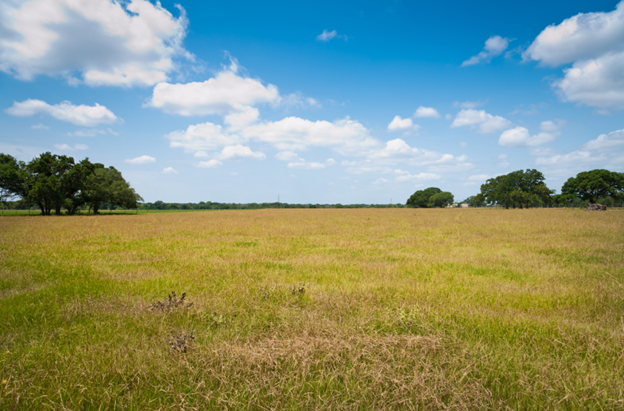
Every livestock producer and land manager in the Midwest and Northeast knows the feeling. It arrives reliably somewhere between the Fourth of July and mid-August. The lush, fast-growing pastures of May and June have slowed to a crawl. The grass looks pale. Growth has stalled. Animals are beginning to push through fences looking for something better. The summer slump has arrived.
The summer slump is not a mystery, and it is not a crisis, unless you let it become one. It is a predictable biological response from cool-season forages that have reached the outer edge of their temperature and moisture comfort zone. Understanding what drives it, which plant species are naturally equipped to fight through it, and how your grazing management either cushions the blow or makes it dramatically worse; that knowledge is the difference between an operation that navigates July and August confidently and one that scrambles to keep animals fed.
At the center of this article is a single organizing principle: deep roots are your best insurance policy against a dry July. The plants that maintain productivity when the rain stops falling are almost always the ones whose root systems are still finding moisture in the subsoil long after the top two inches of ground have turned to dust. Choosing your forage species with that principle in mind, and protecting those root systems with disciplined grazing management, is how you build a pasture that works for you when the season gets hard.
Why the Summer Slump Happens
The summer slump is not caused by any single factor. It is the convergence of several stresses that hit cool-season forages simultaneously during the most demanding weeks of the growing season.
High soil and air temperature are the primary drivers. The optimum temperature for perennial cool-season grasses is between 60°F and 80°F, anything above this range causes a dramatic decline in growth. The second factor is the nature of summer regrowth itself. After the spring peak, cool-season grasses produce primarily vegetative growth made up of leaves. That vegetative canopy is shorter than the reproductive canopy of spring, and therefore less efficient at intercepting light and driving photosynthesis. The third factor is limited soil moisture. Low soil moisture restricts the movement of nutrients through the soil profile, causes stomata to close, and limits the plant's ability to absorb carbon dioxide and maintain turgor.
Cool-season grasses are highly dependent on regular rainfall, with 1 to 1.5 inches per week needed for sustained optimal growth through the summer. While dry and hot conditions in July and August frequently result in a summer slump, longer periods of deficient rainfall can dramatically reduce pasture production. Poor management during drought can slow pasture recovery after the rain starts falling again.
The problem compounds when grazing pressure is added on top of heat and moisture stress, which is exactly what happens on most farms during the slump, because animals are eating more aggressively as the pasture slows down. That combination of increased grazing pressure and decreased plant vigor is where stands genuinely get damaged, and where the long-term productivity of a pasture can be set back months or even years.
The Root Connection: Why Deep Roots Change Everything
The single most useful thing you can understand about summer forage performance is the direct relationship between root depth and drought resistance. It is not complicated: plants with deep roots can access moisture that shallow-rooted plants simply cannot reach. During a dry July, that difference in root depth is the difference between a plant that stays productive and one that goes dormant or dies.
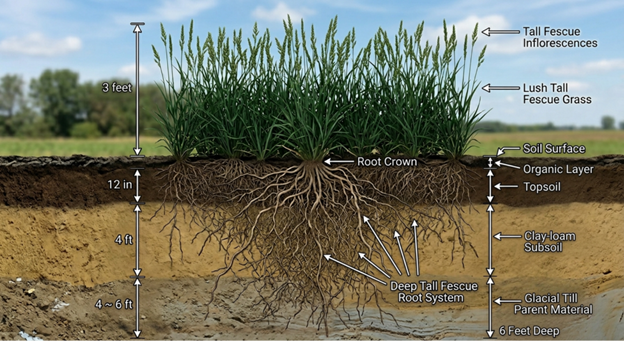
Tall fescue develops a deep and extensive root system, often reaching depths of 2 to 3 feet under optimal soil conditions. These deep roots allow it to tap into moisture reserves far below the surface, helping it survive extended dry periods. In contrast, Kentucky bluegrass typically has a shallower root system that travels laterally along the soil profile, usually extending only 6 to 12 inches, making it far more vulnerable to drought stress during prolonged dry spells.
The same principle holds across the full range of forage species. Legumes with pronounced taproots, alfalfa, yellow blossom sweet clover, chicory, birdsfoot trefoil, maintain productivity during summer stress far better than shallow-rooted grasses because their roots are actively mining moisture from depths that surface-dependent species cannot access.
Species Spotlight — Birdsfoot Trefoil: One of the most underutilized legumes in Midwest pastures, Birdsfoot Trefoil brings a combination of qualities that make it particularly valuable in a dry land forage system. As a dryland pasture legume, birdsfoot trefoil produces 20% more growth after July 1 than most dryland grass-legume mixtures. It is non-bloating, one of the very few high-quality pasture legumes that can be grazed freely without bloat risk, and its deep-rooting system allows it to access moisture and nutrients from deeper soil layers, ensuring sustained growth even in challenging environments. For operations where bloat management adds complexity to summer grazing, birdsfoot trefoil's tannin content is a meaningful practical advantage. It is slower to establish than red or white clover and requires more careful seedbed management but once established it can persist in a well-managed pasture for many years.
Species Spotlight — Yellow Blossom Sweet Clover: Yellow Blossom Sweet Clover has a determinate taproot up to one foot long with extensive branches that may penetrate five feet to aerate subsoils and lessen the negative effects of compaction on crops. It is the most drought-tolerant of all cover crops that produce as much biomass and is especially resilient in its second year, when it could do well in a dry spring during which it would be difficult to establish annual cover crops. Our Yellow Blossom Sweet Clover is particularly well-suited to fields with compaction layers that limit water infiltration; its deep root channels improve the soil structure that allows moisture to move through the profile rather than running off the surface.
In general, legume species such as alfalfa perform better than grasses during dry weather due to a deeper taproot system resulting in better water use efficiency. When cool-season grasses suffered severe summer slump in drought years, warm-season species and deep-rooted legumes were still able to grow and produce.
This is why the species composition of your pasture matters as much as, and sometimes more than, your grazing management when it comes to surviving summer. A well-managed stand of shallow-rooted grasses will still struggle in a dry July. A diversified stand that includes deep-rooted species has structural drought resistance built into its genetics.
The Pastureland Dry Land Mix: Built for This Problem
Deer Creek Seed's Pastureland Dry Land Mix is the purpose-built solution for producers managing pastures in lower-rainfall environments, drought-prone regions, or fields with light, sandy, or shallow soils that dry out faster than average. Rather than leaning on cool-season species that demand consistent moisture to perform, the Dry Land Mix is formulated around species selected specifically for their ability to maintain productivity under the kind of heat and moisture stress that defines a Midwest summer at its worst.
The foundation of any dry land forage system is tall fescue, and for good reason. Tall fescue has the highest heat, traffic, and drought tolerance of the cool-season grasses. It forms a deep root system tolerant of clay and alkaline soils and is often used where a low-maintenance stand is desired on ground that would stress other species into dormancy. Where Kentucky bluegrass-dominated pastures go brown and dormant in a dry August, tall fescue continues to produce, sometimes modestly, but consistently, because its root system is still finding water.
The Dry Land Mix pairs a robust, deep-rooted grass base with drought-tolerant species designed to withstand moisture stress. Featuring a balanced formulation of Tall Fescue, Orchardgrass, Festulolium, Annual Ryegrass, and Crested Wheatgrass, this blend develops the deep root architecture needed to remain structurally resilient. The result is a system that does not just survive the summer slump, it produces through it.
Grazing Management: The Variable You Control Every Day
Species selection determines your ceiling. Grazing management determines whether you reach it or fall well short.
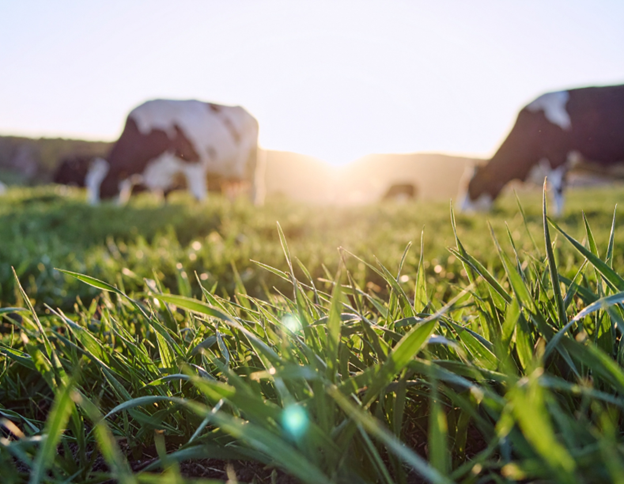
During the summer slump, the most damaging thing a producer can do is allow continuous, unrestricted grazing pressure on a pasture that is already heat and moisture stressed. The consequences of that mistake show up not just in July but in the following fall, and sometimes in the following spring, as stands that were grazed too short struggle to rebuild root reserves and competitive vigor.
The graze half, leave half rule is especially critical during the summer slump. Research has shown that if grasses are grazed very short repeatedly, the root system dies back significantly and the stand declines. Maintaining at least 3 to 4 inches of standing pasture is the general rule of thumb, but during the summer slump this minimum is more important than at any other time of year. The standing residual shades the crown and tillers, providing protection from high soil temperatures, root growth is more sensitive to soil temperature fluctuations than shoot growth is to air temperature.
Grazing shorter than 3 to 4 inches leads to higher surface soil temperatures, exposing tillers to temperatures as high as 95°F compared to temperatures in the mid-70s under a well-developed canopy. The high temperatures can cause new tillers to die. Additionally, the energy reserves for regrowth in many cool-season grasses are stored in the stem just above the soil surface, by grazing too low, those reserves are removed, causing slower and weaker regrowth.
When these principles are applied, never depleting carbohydrate reserves, maintaining a well-developed root system, keeping the soil surface covered to preserve moisture, and maximizing regrowth potential, the benefits compound. Well-established grasses with deep root systems will bounce back after moisture returns. Overgrazed grasses with shallow root systems will become drought stressed faster and recover more slowly.
The practical implication: during the summer slump, your rotation should slow down, not speed up. As cool-season pastures begin slowing their growth and go through the summer slump, rotations should slow, giving the forage longer rest periods to recover. Giving forage longer rest periods during this time allows carbohydrate reserves to rebuild before the next grazing event. If you are running a rotational system, extend the rest interval between paddocks. If animals are running out of grass before the paddocks are ready, that is the signal to reduce stocking density, move animals to a sacrifice area, or supplement with stored forage, not to graze the standing paddocks harder.
The Sacrifice Area Strategy
One of the most effective tools for protecting the long-term productivity of a pasture system during the summer slump is the sacrifice area, a designated paddock or lot where animals are concentrated during drought stress, allowing the rest of the farm to rest and recover without grazing pressure.
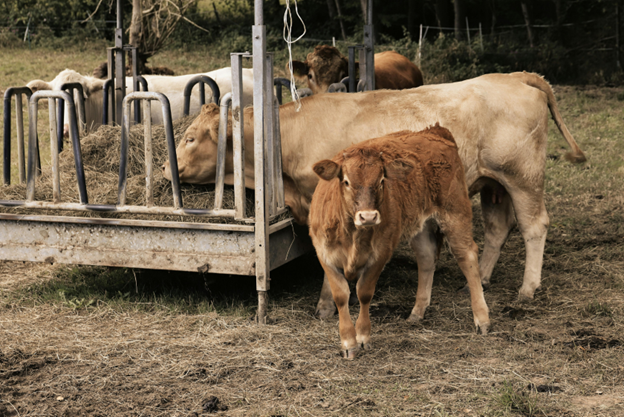
If you only have cool-season pastures, bringing animals into a dry lot, feeding reserved forages for a few weeks, and allowing the grasses to regrow will help increase stand longevity and reduce the need to reseed a stand that has become thin from overgrazing. If a dry lot is not an option, consider using a section of pasture that is in poor condition and needs attention. The extra nutrients provided from animal urine and manure can supply fertility, and the pasture can be reseeded in the fall if necessary, once the animals are removed.
The sacrifice area is not a failure; it is a calculated trade-off. You damage one paddock deliberately to protect the rest of the system. That investment in rest pays dividends when temperatures cool and fall moisture returns, allowing protected paddocks to recover quickly and build the carbohydrate reserves they will need to overwinter well and come back strong the following spring.
Warm-Season Annuals as a Summer Bridge
For operations that want an active forage bridge during the slump rather than simply waiting it out, warm-season annuals are the highest-impact tool available. These species grow when cool-season grasses don't, thriving in the heat of July and August that causes cool-season species to stall.
Warm-season annuals are adapted to the heat of summer and do not readily germinate until soils reach 65°F, but they grow well at temperatures up to and exceeding 90°F. Prime warm-season grasses suited for multiple summer grazings include sorghum-sudangrass and pearl millet. These species are adapted to hot and dry conditions and can produce when cool-season perennials have essentially stopped.
Our Pastureland Dry Land Mix is designed to reduce the need for emergency warm-season annual plantings by establishing a base stand with built-in summer resilience. But for operations already dealing with severe slump conditions, pairing the Dry Land Mix with a summer annual bridge crop is a practical combination that ensures continuous forage availability from spring through fall.
After the Drought: Don't Rush Back
One of the most common, and most damaging, mistakes producers make after a summer drought breaks is returning animals to pasture too quickly once the rain returns. The instinct is understandable. The grass is greening up. The animals are hungry. The pasture looks ready.
It is not ready.
Once temperatures cool and moisture return, you will be tempted to graze too short or too soon, do not. Pastures need time to regrow above and below ground before grazing resumes. Deeper roots help ensure the plant can continue to scavenge for water and nutrients. Grazing too soon after a drought will further deplete any energy the grasses had stored, causing roots to die off. Allow grasses to reach a height of at least 8 to 10 inches when rotationally grazing before reintroducing animals and avoid overgrazing even after moisture returns.
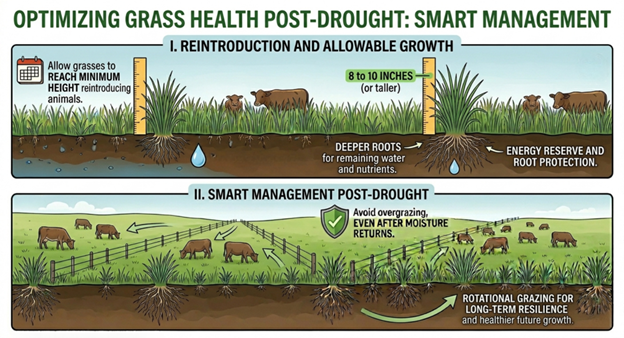
The root system rebuilds from the bottom up. The green growth you see at the surface is the visible indicator of recovery, but the invisible recovery happening underground, root regeneration, carbohydrate storage, nodule activity in legumes, takes additional time beyond what the canopy height alone suggests. Give it that time, and the stand will come back stronger and more competitive. Rush it, and you set the process back again.
Building a Drought-Resilient System: The Long View
The summer slump cannot be eliminated. It is a feature of cool-season forage production in continental climates, and it will return every year. What can be changed is how hard it hits.
The producers who navigate summer droughts most successfully share a common set of choices: they have invested in species with deep root architectures, they manage their grazing residuals consistently and resist the temptation to graze too short when the pressure mounts, they have a sacrifice area strategy in place before they need it, and they think about summer forage availability at seeding time in the fall, not in June when the problem is already arriving.
The Pastureland Dry Land Mix, our Birdsfoot Trefoil, Yellow Blossom Sweet Clover, and Chicory are the tools available to build that resilience into the ground itself, season after season.
Deep roots are not a luxury in a dry July. They are the only thing that keeps the stand producing when everything else has stopped.
Sources
- Penn State Extension. Grazing During the Summer Slump. https://extension.psu.edu/grazing-during-the-summer-slump
- Penn State Extension. Evaluating and Maintaining Pastures in Dry Conditions. https://extension.psu.edu/evaluating-and-maintaining-pastures-in-dry-conditions
- Penn State Extension. Changes to Grazing Management in Late Summer and Early Fall. https://extension.psu.edu/changes-to-grazing-management-in-late-summer-and-early-fall
- Penn State Extension. Extending the Grazing Season with Plant Diversity. https://extension.psu.edu/extending-the-grazing-season-with-plant-diversity
- UW-Madison Division of Extension / Crops and Soils. Managing Pastures in Drought Conditions. https://cropsandsoils.extension.wisc.edu/articles/managing-pastures-in-drought-conditions/
- Iowa State University Extension. Pasture Management: Optimizing Grazing and Fertilization. https://www.extension.iastate.edu/smallfarms/pasture-management-optimizing-grazing-and-fertilization
- Michigan State University Extension / The Cattle Site. 8 Ways to Beat the Summer Pasture Slump. https://www.thecattlesite.com/articles/958/8-ways-to-beat-the-summer-pasture-slump-2
- Iowa State University Extension. Turf-Type Tall Fescue — Drought and Heat Tolerance. https://yardandgarden.extension.iastate.edu/how-to/all-about-tall-fescue-low-maintenance-alternative-kentucky-bluegrass
- Utah Turf / Utah State University. Kentucky Bluegrass vs. Tall Fescue: Drought Tolerance. https://utahturf.com/kentucky-bluegrass-vs-tall-fescue-what-makes-tall-fescue-more-drought-tolerant/
- SARE. Sweet Clovers — Yellow Sweetclover Taproot and Soil Benefits. https://www.sare.org/publications/managing-cover-crops-profitably/legume-cover-crops/sweet-clovers/
- USDA PLANTS / NRCS. Birdsfoot Trefoil Fact Sheet. https://plants.sc.egov.usda.gov/DocumentLibrary/factsheet/pdf/fs_loco6.pdf
- Penn State Extension. Birdsfoot Trefoil. https://extension.psu.edu/birdsfoot-trefoil
- Missouri Extension. Birdsfoot Trefoil — Summer Forage Gap. https://extension.missouri.edu/publications/g4640
- Scientific Reports / Nature. Plant Functional Trait Responses to Cope with Drought in Seven Cool-Season Grasses. https://www.nature.com/articles/s41598-023-31923-y
- Powlen et al. (2022). Response of Drought Susceptible and Resistant Kentucky Bluegrass and Tall Fescue Cultivars and Mixtures to Limited Irrigation. Crop Science, 62. https://acsess.onlinelibrary.wiley.com/doi/10.1002/csc2.20789